Plant Nutrient Synergy and Antagonism in Soil
The rising global population is increasing the demand for food production, which places significant pressure on agricultural systems. To meet this demand, farmers rely heavily on fertilizers and nutrient management practices. However, excessive or unbalanced fertilizer use can reduce soil fertility and negatively affect crop productivity. Understanding how nutrients interact in soil and plants is essential for improving nutrient use efficiency and ensuring sustainable crop production.
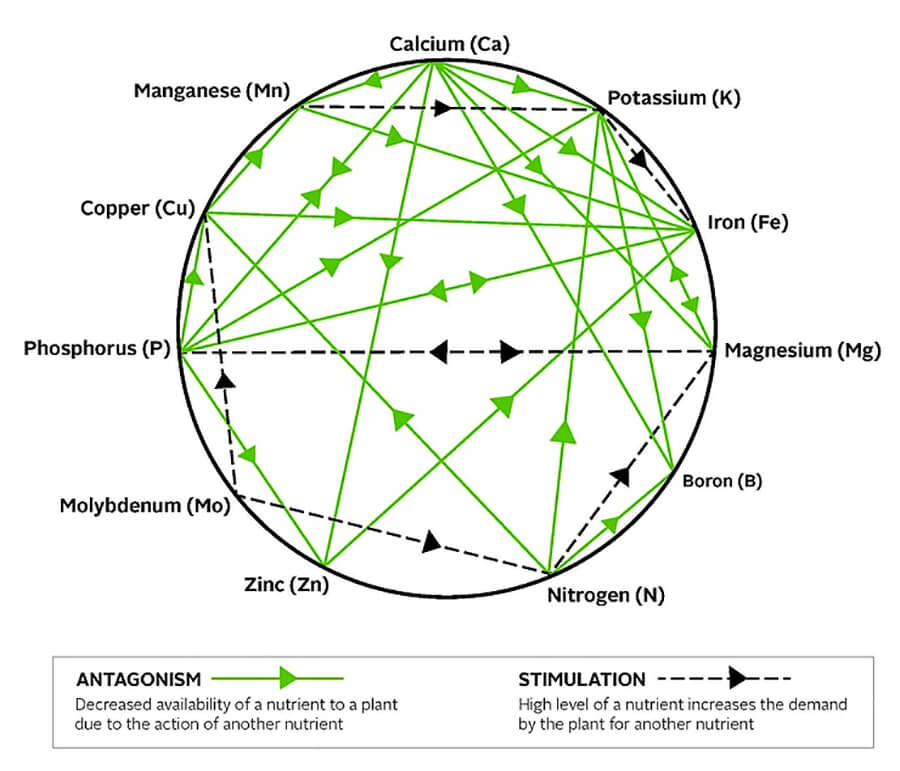
Plant nutrients do not work independently; instead, they interact with each other inside the soil and plant system. These interactions can either improve nutrient uptake or restrict it. Positive nutrient interactions, known as nutrient synergy, enhance plant growth and increase yield. In contrast, negative interactions, called nutrient antagonism, reduce nutrient availability and can lead to deficiency symptoms and yield losses.
Types of Nutrient Interactions
• Synergistic Interaction:
When one nutrient improves the absorption or effectiveness of another nutrient, leading to higher crop yield than expected.
• Antagonistic Interaction:
When excess of one nutrient reduces the uptake or utilization of another nutrient.
• Zero Interaction:
When two nutrients work independently and do not affect each other’s availability or crop response.
Examples of Nutrient Synergy
Nutrient synergy helps improve plant growth through several biological and chemical mechanisms.
• Nitrogen enhances phosphorus uptake by increasing phosphate transporter activity in plant roots.
• Potassium improves water regulation in plants, which supports better transport of nitrogen and other nutrients.
• Sulphur activates nitrate reductase enzyme, helping convert nitrogen into proteins essential for plant growth.
• Ammonium fertilizers slightly reduce soil pH, increasing phosphorus solubility and availability.
• Beneficial microbes like mycorrhiza improve nutrient availability by breaking down organic matter.
These interactions improve nutrient use efficiency and reduce fertilizer losses, resulting in better crop productivity.
Examples of Nutrient Antagonism
Nutrient antagonism occurs mainly due to competition between nutrients or chemical reactions in soil.
• Excess phosphorus reduces zinc uptake, leading to stunted plant growth and smaller leaves.
• High potassium levels reduce magnesium absorption, causing yellowing between leaf veins.
• In acidic soils, phosphorus reacts with iron and aluminium, forming insoluble compounds.
• In alkaline soils, phosphorus binds with calcium, reducing its availability.
• Excess iron can interfere with the uptake of manganese, zinc, and phosphorus.
Conclusion
Balanced nutrient management is crucial for sustainable crop production. Nutrient synergy improves nutrient efficiency and crop yield, whereas nutrient antagonism can cause deficiencies and reduce productivity. By adopting scientific nutrient management practices, farmers can maintain soil health, improve fertilizer efficiency, and ensure long-term agricultural sustainability.